After the US ground stop was lifted: flights came back slowly, not in one wave
On the evening of Friday, November 13, 2026, the ground stop that had halted takeoffs at every US airport for more than four hours was lifted. The stop began at 3:54 PM Eastern time, and its lifting was announced at about 8:15 PM.
In our article about the day of the stop we expected the held flights to come back in one close wave. The numbers said something different, and we show it here as it is. This article is for rideshare drivers, taxi drivers and chauffeurs: what happened after the lift every 15 minutes, and how to act next time. All times are Eastern time, and all numbers are estimates.
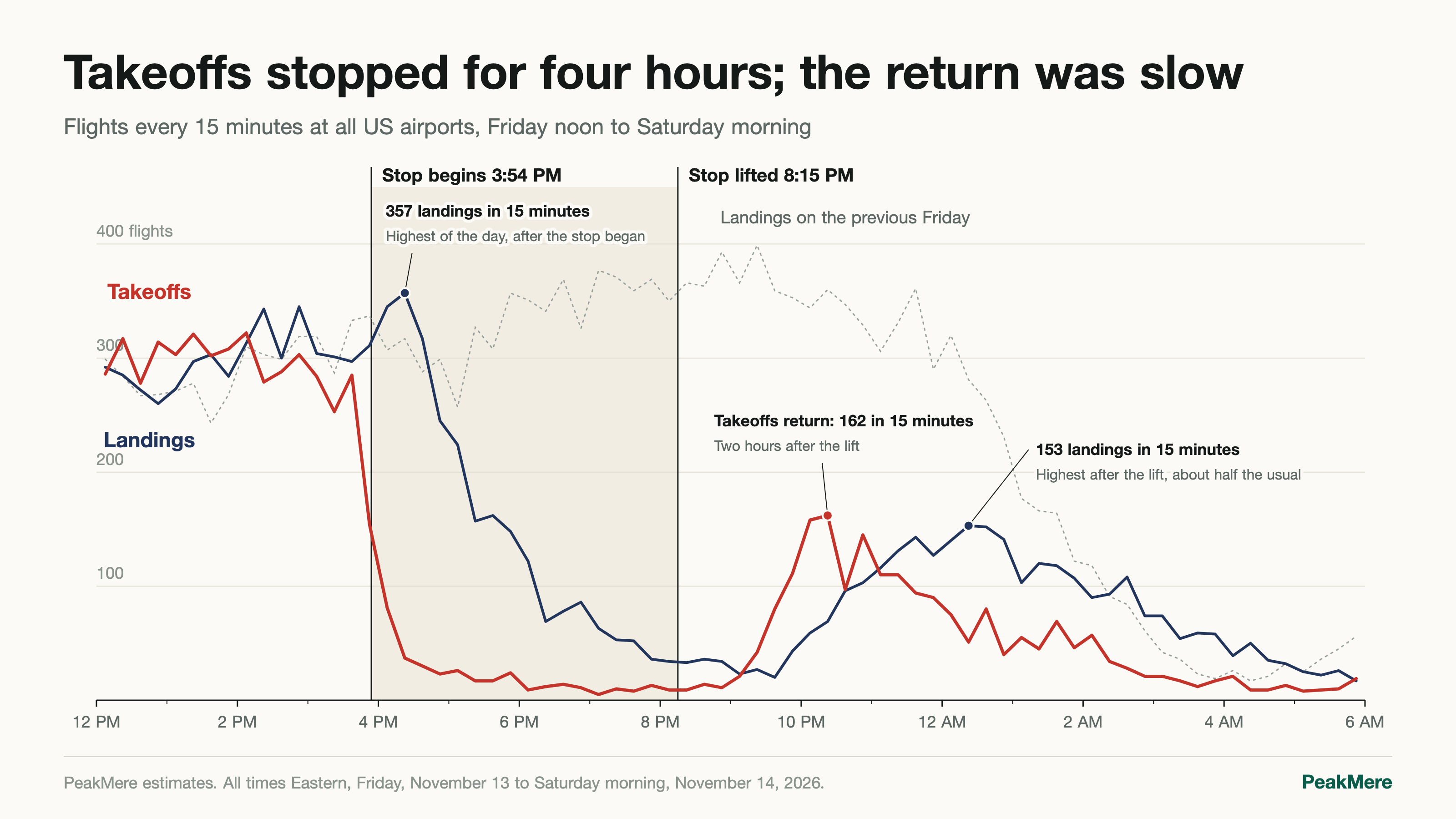
The short answer
- A lift does not mean an instant return. Takeoffs stayed almost stopped for about an hour after the lift, then began to climb at 9:15 PM.
- No single big wave came. The highest landing count after the lift was 153 flights in 15 minutes after midnight, about half the usual level for that hour.
- The extra came late at night. Between 3:00 AM and 5:00 AM, 401 flights landed, against 216 a week earlier.
- For drivers: do not wait for a wave at the lift. Expect a weak evening, a longer night than usual, and a lighter next day.
What "lifting the stop" means
A lift is permission to take off, not a takeoff. After four hours of standstill, the planes are not all ready at the same moment. Passengers have scattered, some flights were canceled, and what remains takes off one flight after another.
Our estimates recorded this clearly. Between 8:15 PM and 9:00 PM, the first 45 minutes after the lift, only 34 flights took off. On the previous Friday, 898 flights took off in the same period.
We also recorded more than 7,000 canceled flights on Friday, against 366 on the previous Friday. A canceled flight does not come back after the lift, which is why the return was smaller than the stop.
Six hours after the lift, every 15 minutes
Every 15 minutes we count the flights headed to a US airport that took off, and the flights that landed. The last column is landings in the same period on the previous Friday.
| Period (Eastern time) | Takeoffs | Landings | Landings, previous Friday |
|---|---|---|---|
| 8:00 PM to 8:15 PM (before the lift) | 9 | 34 | 350 |
| 8:45 PM to 9:00 PM | 11 | 34 | 393 |
| 9:15 PM to 9:30 PM | 42 | 27 | 399 |
| 9:30 PM to 9:45 PM | 80 | 20 | 359 |
| 10:15 PM to 10:30 PM | 162 | 69 | 360 |
| 11:00 PM to 11:15 PM | 110 | 116 | 306 |
| 12:15 AM to 12:30 AM | 51 | 153 | 281 |
| 1:15 AM to 1:30 AM | 45 | 120 | 166 |
| 2:30 AM to 2:45 AM | 28 | 108 | 84 |
| 3:30 AM to 3:45 AM | 12 | 59 | 23 |
| 4:15 AM to 4:30 AM | 9 | 50 | 17 |
Read the last two columns from top to bottom. Early in the night landings were a small part of the usual: 20 instead of 359. After midnight they came close to it. After 2:30 AM they passed it. The flights did not all disappear; part of them ran hours late.
The night of the return, step by step
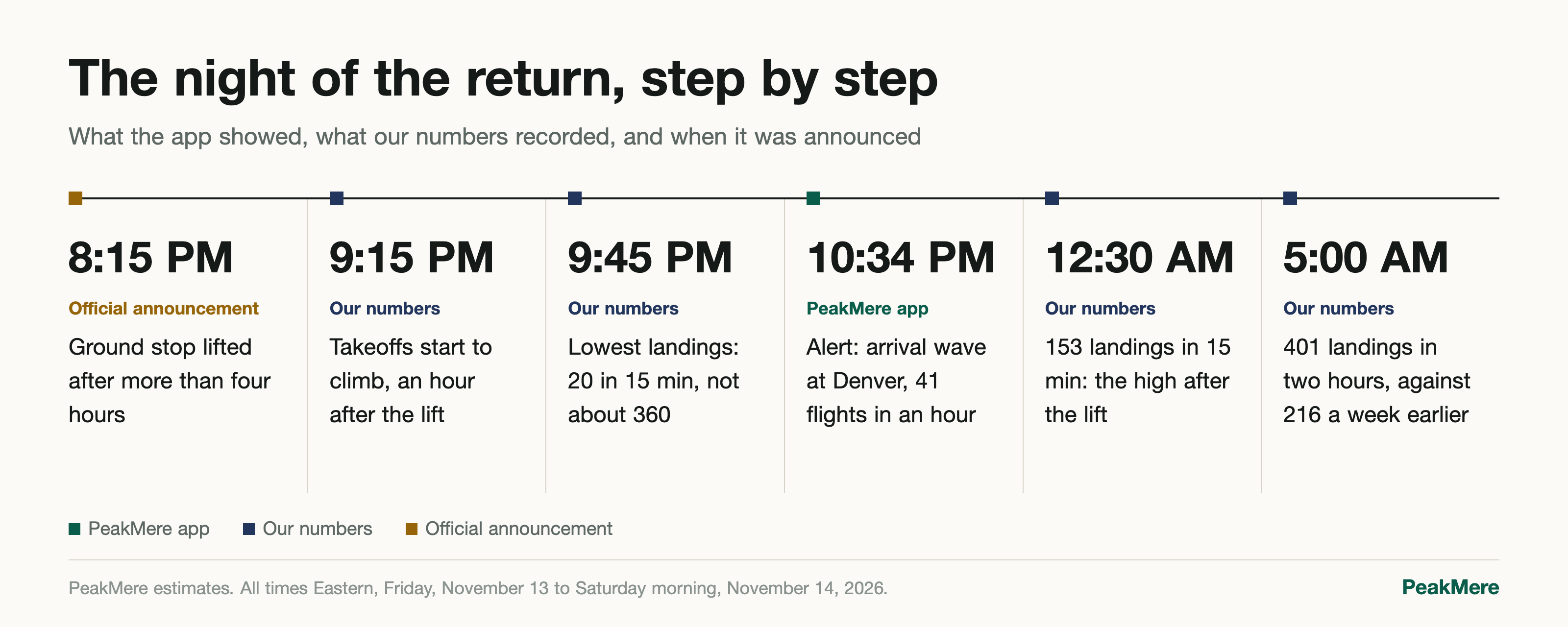
- 8:15 PM: the ground stop is lifted.
- 9:15 PM: takeoffs begin to climb. In the next 15 minutes there were 42, then 80, then 111.
- 9:45 PM: landings at the lowest number of the night: 20 in 15 minutes.
- 10:30 PM: takeoffs at the highest number after the lift: 162 in 15 minutes, about three quarters of the previous Friday.
- 10:34 PM: the app alerts to an arrival wave at Denver: 41 flights within an hour, most of them delayed.
- 12:30 AM: landings at the highest number after the lift: 153 in 15 minutes.
- 3:00 AM to 5:00 AM: 401 landings in two hours, against 216 a week earlier.
Why no single wave came
A wave needs takeoffs close together. That did not happen.
Takeoffs climbed over an hour, from 21 in 15 minutes at 9:00 PM to 158 at 10:00 PM. Then they stayed below usual: the highest number was 162, and the previous Friday had 214 in the same period. After 11:00 PM they fell with the end of the day, as on any night.
Flights also differ in length. A plane that took off at 9:30 PM lands an hour later if its flight is short, and four hours later or more if it is long. So takeoffs spread over about three hours became landings spread until dawn.
The result in our numbers: from the lift to 2:00 AM, 2,094 flights landed, against 6,991 on the previous Friday. Less than a third.
Late at night: empty hours filled up
This is the part that matters for anyone who works at night. Between 2:15 AM and 4:45 AM, landings were higher than on the previous Friday in every 15 minutes. And between 3:00 AM and 5:00 AM, 401 flights landed against 216.
The numbers are small compared with daytime. But these are hours when the airport is usually almost empty. Few drivers are out, the train may have stopped running, and a passenger who arrived six hours late wants to get home.
The return differed from airport to airport
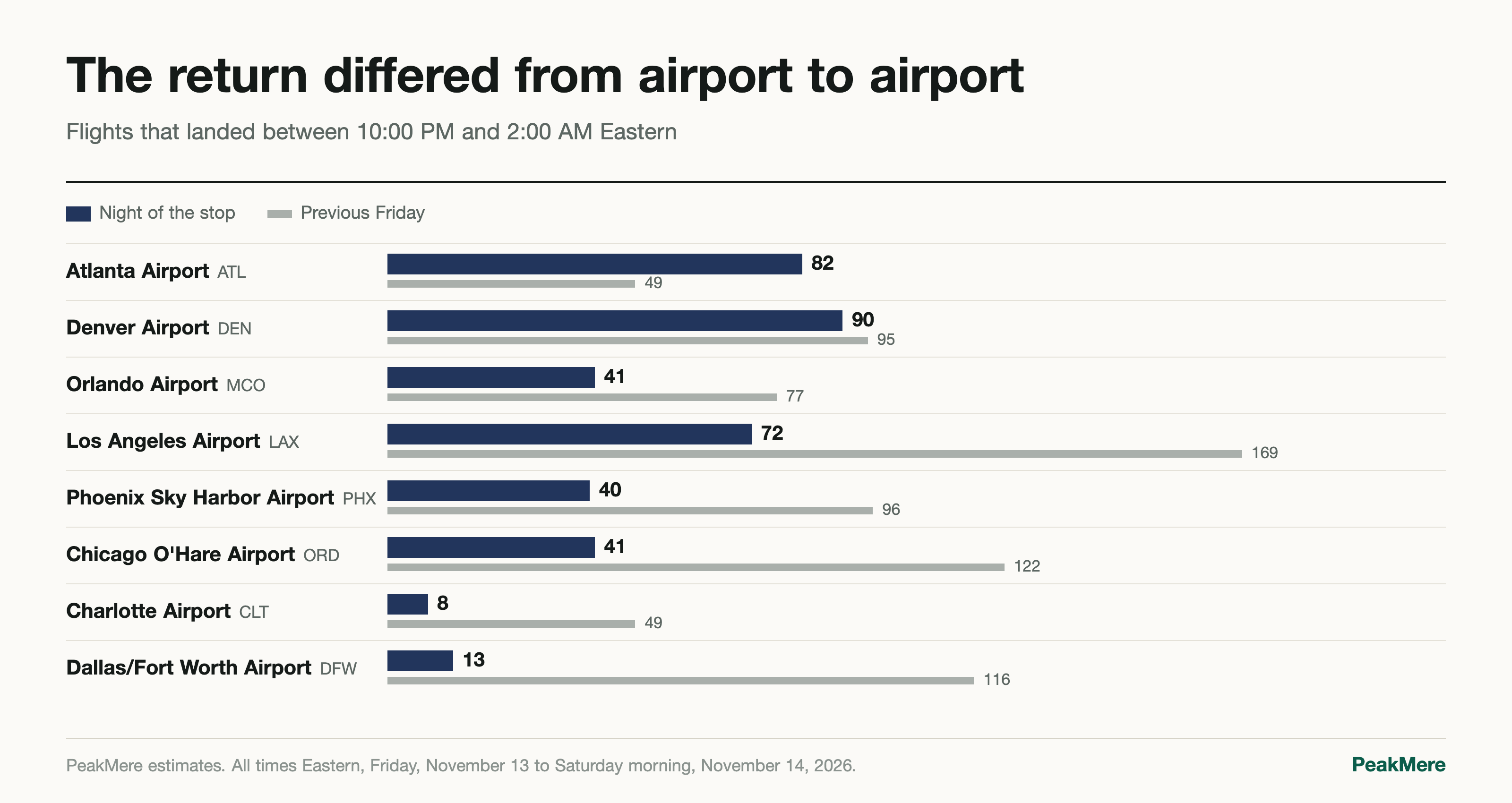
This is the number of flights that landed between 10:00 PM and 2:00 AM Eastern time:
| Airport | Night of the stop | Previous Friday |
|---|---|---|
| Atlanta Airport (ATL) | 82 | 49 |
| Denver Airport (DEN) | 90 | 95 |
| Orlando Airport (MCO) | 41 | 77 |
| Los Angeles Airport (LAX) | 72 | 169 |
| Phoenix Sky Harbor Airport (PHX) | 40 | 96 |
| Chicago O'Hare Airport (ORD) | 41 | 122 |
| Charlotte Airport (CLT) | 8 | 49 |
| Dallas/Fort Worth Airport (DFW) | 13 | 116 |
At Atlanta the late evening was busier than an ordinary Friday. At Denver it was close to one, and then it kept going: between 11:00 PM and 3:00 AM Eastern, 108 flights landed at Denver, against 67 a week earlier. At Dallas and Charlotte almost no return came that night.
Airports in the same country on the same night, with opposite pictures. The national news does not tell you what is happening at your airport.
What the app showed at Denver
We followed the app's alerts at Denver Airport (DEN) that night, and compared them with what our estimates recorded afterward:
- 10:34 PM: an arrival wave alert: 41 flights within the hour from 11:05 PM to 12:05 AM, 39 of them delayed. We recorded 31 landings in that hour, against 19 a week earlier.
- 12:10 AM: a "wave landing now" alert: about 2,500 passengers in half an hour, where about 1,500 is usual.
- 1:10 AM: a second arrival wave alert: 34 flights within an hour. We recorded 29 landings, against 10 a week earlier.
- 3:04 AM: a "wave landing now" alert: about 2,100 passengers in half an hour, where about 700 is usual.
The first alert expected 41 flights and we recorded 31. The direction was right, and the number was higher than what we recorded. We say so because an alert is an estimate, not a promise.
What did not show that night was the national stop itself. The app showed stops airport by airport, so it did not show it at most airports. We closed this gap the next day: since November 14, the ground stop card appears at every airport when a nationwide stop is announced.
The next day: a lighter Saturday than usual
The return was not finished overnight. On Saturday from 6:00 AM to 11:00 PM we recorded 14,507 landings, against 19,980 on the previous Saturday. About 27% fewer.
- The morning was the weakest. Between 6:00 AM and 9:00 AM, 745 flights landed, against 1,542 a week earlier. Less than half.
- Midday improved. Between 12:00 PM and 3:00 PM, 2,877 flights landed, against 3,994. About 72%.
- The evening came close to usual. Between 7:00 PM and 11:00 PM, 4,234 flights landed, against 4,947. About 86%.
On Saturday we recorded more than 7,000 more canceled flights, against 103 on the previous Saturday. The schedule was not whole again until Saturday evening.
What a driver does after a stop is lifted
- Do not go to the airport on the news of the lift. In our numbers an hour passed before takeoffs came back, and an hour and a half before landings began to climb.
- Look at your airport, not at the news. Atlanta filled up and Dallas stayed empty on the same night.
- Your city may be better early in the evening. Landings stayed below half the usual level until midnight.
- If you work nights, this is your night. Delayed flights land after midnight and until dawn, in hours with few drivers.
- The departures hall moves too. Travelers whose flights were canceled ask for a ride home or to a hotel, then come back to the airport in the morning.
- Plan for a lighter morning. The next morning was below half the usual level in our numbers.
- Follow the signs and airport rules, and rest if the wait is long. A long night is not worth driving tired.
Quick questions
How long passed between the lift and the return of flights? About an hour before takeoffs climbed, an hour and a half before landings began to climb, and four hours until the highest landing count.
Does a big wave come after the lift? Not this time. The highest landing count after the lift was about half the usual level. The extra above usual came between 3:00 AM and 5:00 AM.
Do all airports come back together? No. Between 10:00 PM and 2:00 AM, 82 flights landed at Atlanta against 49 on an ordinary Friday, and 13 at Dallas against 116.
When does everything get back to normal? Not on the same night. In our numbers Saturday's landings were about 27% lower, and came close to usual in the evening.
What these numbers do not say
These are estimates, not an official record. We count flights, not passengers who request a ride. The comparison with "the previous Friday" and "the previous Saturday" is a comparison with one day, not with an average of weeks. The numbers for a single airport are small, so read them as a direction. And this was one stop that lasted more than four hours; a shorter stop, or one at another time of day, may come back differently. Nothing here is a promise of requests or income.
PeakMere shows you your airport's activity hour by hour, so after a stop is lifted you know when to move and where.